
It has been a while since I have written my last post. I finished the first chapter and will be making some minor adjustments to the chapter and then it will be complete. The new semester starts on Monday and it looks to be a fun start. Primarily I will be focusing on Chapter 2 of my thesis while working on outlines for chapters 3, 4, and the conclusion.
So how has this process worked thus far? Well, it has been smooth, lots of emails back and forth with distinguished professors who I trust and admire as mentors. Lots of research using archives such as the National World War II Museum and the Air Force Historical Research Agency, and a lot of reading. My book collection has grown, and new source material was gathered over the Christmas break. Research at times can seem intimidating when trying to decipher After Action Reports which are often illegible. However, with patience, some of these reports yield valuable information.
Chapter 2
This term it appears that I will be focusing primarily on Chapter 2. This chapter and the next will be the heart and soul of my thesis. They are the essential key to understanding Chennault, Boyington and Doolittle, their leadership and the success of their squadrons. It will be in this chapter that I get to explore oral histories in depth to truly come to know these commanders through the eyes of those who served under them. Oral histories are valuable to historians for the perspective they provide into the events of the past. By utilizing them, we can better understand what was occurring at the time, the perception of events by those who were participants, potential motives that lay at the heart of the event and an overall impression of the outcome.
Many of the oral histories I have collected come from the Doolittle Raiders, who on April 18, 1942, led an attack on Japan. A top-secret mission designed to show the Japanese that the events at Pearl Harbor did not destroy our nation, Doolittle and his Raiders were able to successfully drop several bombs on strategic locations. It would be a full year before the public knew of the mission and the success. Tragically, some of the Raiders did not return home, having been forced to abandon their B-25s before they could reach their refueling station, eight of the men were captured by the Japanese of which three were executed. For years the surviving men gathered for reunions in various cities to remember the mission and those they lost.
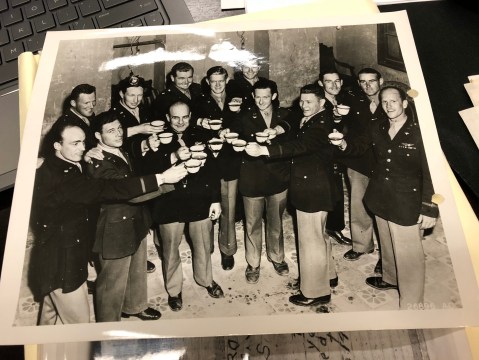
Major General James Doolittle and his Raiders April 1943 Reunion in North Africa. **Photo from the Doolittle Raider Collection at the Air Force Historical Research Agency.
This collection of oral histories, after action reports and newspaper clippings, is truly something to behold. Can you imagine being so far away from home, flying one of sixteen B-25s over enemy territory, a crash landing and having to evade the enemy who went on a spree terrorizing the Chinese for helping the men of Doolittle’s unit? For us it might seem impossible, but yet for the men of this unit, this is precisely what they endured. By reading their experiences during this time enables the historian to put together a clear, unbiased, yet concise profile that engages the past to enable a reader to vividly understand and potentially envision what they might do in their place.
This is just a small view of the research I have been doing this year. I am looking forward to exploring more of these histories along with that of Chennault’s Flying Tigers and Boyington’s Black Sheep. For those who may not know, Boyington was a Flying Tiger member, despised Chennault, yet modeled himself after his former commander as the head of the Black Sheep.

 The Solitary Historian
You must be logged in to post a comment.