Henry Obediah Barber

            Utilizing genealogy as a means of understanding the past can often present some exciting challenges. However, with the ever-increasing digitalization of primary source materials such as marriage licenses, death certificates, town directories, and census reports, often open the window to valuable information.
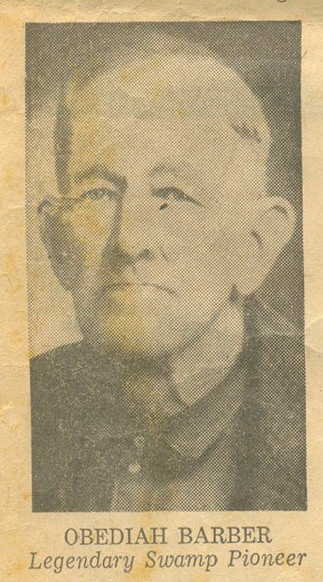
Henry Obediah Barber

            Henry “Obediah” Barber is my fourth great grandfather through my maternal granny’s father’s line. I did not know about Obediah growing up; it was only in the more recent years that I discovered this connection to a larger than life frontiersman. Obediah was born on July 15, 1825, to the Reverend Isaac Barber and Catherine Frances Sikes in Bryan County, Georgia.[1]
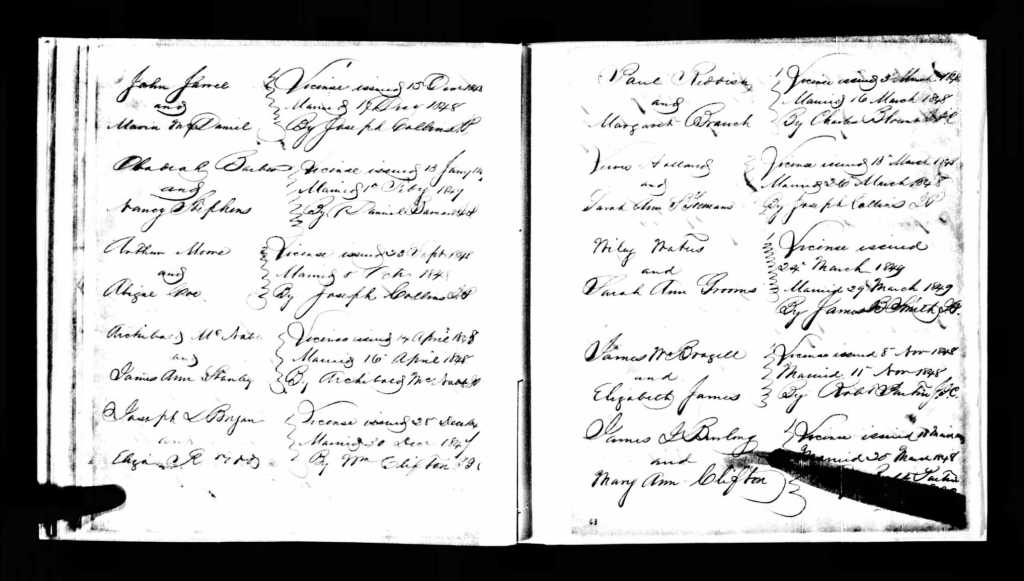
On February 1, 1849, he married Nancy Stephens, and together they eventually had eleven children. One of those being my third great grandmother Julia Barber. He was a tall man with a height of around 6 ½ feet.  In 1857, 1875, and 1890 Obediah acted as a guide to the swamp for a surveying party.

            Sometime in 1854, Obediah purchased a 490-acre lot on the Okefenokee Swamp’s northeastern side and moved his family on to the land. Obediah served as a Justice of the Peace in Ware County and subsequently in Pierce County when the boundary was moved between 1857 and 1870. Unfortunately, I do not know much about his time as a Justice of the Peace due to records not being digitalized as of now. Maybe one day, they will be done so that I can access them for further research.  Based on census records for 1850-1860, it does not appear that Obediah had slaves; having a large family, he may have utilized his family as labor.[2]
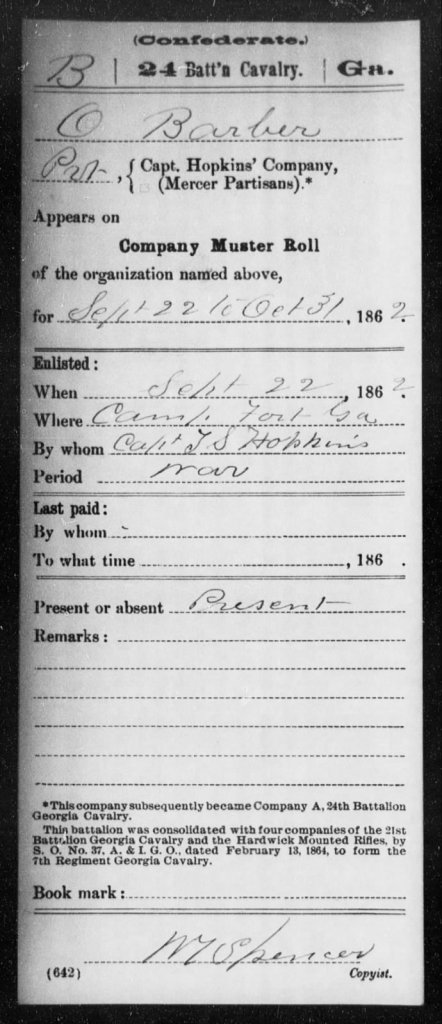
The Civil War was a turning point in our nation’s history. Obediah served during the war as part of Mercer’s Partisans with Captain Thomas Spaulding Hopkins Mounted Partisan Rangers.[3]  On September 22, 1862, he enlisted at Camp Fort, where Captain Hopkins swore him in. Looking at his service records, it is evident that Captain Hopkins trusted him as between November and December 1862. He was sent to pursue a deserter. In an exciting twist, Obediah, himself, is recorded as having deserted on July 19, 1863.[4]

            In 1870, Obediah resigned as justice of the peace, sells his current home, and moves his family six miles across the swamp to a new farm. It is here that he built a log cabin for the family that survives to this day.  In 1874, his beloved Nancy died. Obediah remarried in 1875 to Matilda Tatum, with whom he fathered nine more children. If you are keeping track, that means Obediah had twenty children between two wives. By 1850, Obediah owned around 1500 acres of land and several working oxen and horses. In addition to crops such as rice, sugarcane, oats, and sweet potatoes, he farmed cattle, hogs, and chickens.[5]  There are interesting stories of Obediah killing a bear with a butcher knife, killing large snakes with his bare hands. Student biologists turned to him for information on the various animals and foliage found in the swamp. It is reported that authors and writers even utilized him for his knowledge, thus earning him the nickname “King of the Okefenokee.” [6]
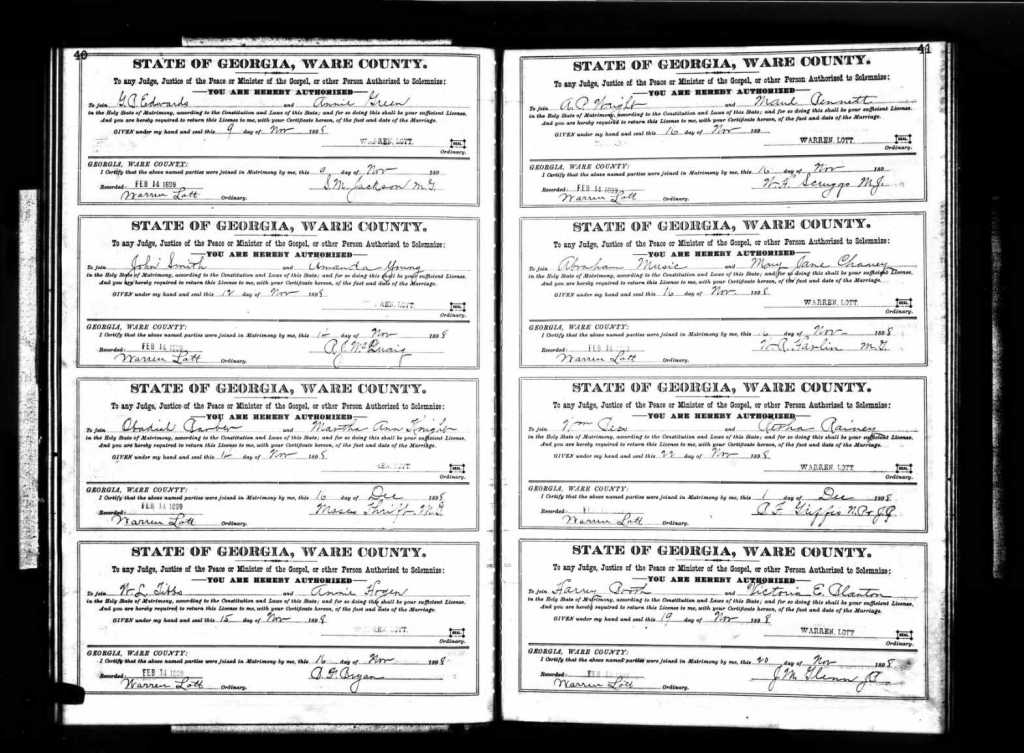
            In 1898 his second wife, Matilda, died. At the age of 73, Obediah remarried a woman forty-seven years younger than him named Martha Ann Knight. The marriage did not last long, as Obediah suffered a stroke in 1903, and by 1907, Martha Ann divorced Obediah. He spent the last two years of his life under the guardianship of his children. Obediah died on December 28, 1909, having lived a full and fascinating life. Today, he is remembered as a pioneering legend in Ware County, Georgia.

            His 1870 cabin still stands and today is listed on the National Registry of Historic Places. The report states that it is significant as it is the only surviving home of its period remaining in the swamp. Furthermore, the land the home stands on is known as Obediah’s Okefenok.[7]


[1] National Register of Historic Places, Obediah Barber Homestead, Waycross, Ware County, Georgia, National Register #93500742.

[2] Ancestry.com. 1860 United States Federal Census [database on-line]. Provo, UT, USA: Ancestry.com Operations, Inc., 2009. Images reproduced by FamilySearch. Original data:1860 U.S. census, population schedule. NARA microfilm publication M653, 1,438 rolls. Washington, D.C.: National Archives and Records Administration, n.d.

[3] Fold3, Civil War Soldiers – Confederate – GA (/title/31/civil-war-soldiers-confederate-ga:accessed October 7, 2020), database and images, https://www.fold3.com/title/31/civil-war-soldiers-confederate-ga

[4] Ibid. 8.

[5] Ancestry.com U.S. IRS Tax Assessment Lists,1862-1918 [database on-line]. Provo, UT, USA: Ancestry.com Operations Inc., 2008.

[6]  Walker, Laura Singleton. History of Ware County, Georgia. Macon, Ga.: J.W. Burke Co., 1934: 334-335.

[7] National Register of Historic Places, Obediah Barber Homestead, 6.

Posted in History | Leave a comment

Christianity During the American Civil War

The role of religion in America during the Civil War was multifaceted. On the one hand, you had the division of churches into Old and New Schools. While on the other hand, churches, both North and South, maintained that God was on their sides. The following exploration is a comparison of two sermons, both proclaiming to be sermons preached on a day of thanksgiving and prayer, yet two completely different sermons.  

            The first sermon comes from Maximilian J. Michelbacher, a Jewish priest of prominence living in Confederate-held Richmond, VA.  Michelbacher immigrated from Bavaria in 1844 and arrived in Richmond in 1846. His congregation at Beth Ahabah was of the Ashkenazic form of worship. Michelbacher loved education and learning, and thus he and his congregational built the first Jewish school in Richmond. It was eventually closed so that the city could use its facilities for the formation of the Richmond Public School System. Michelbacher was their first rabbi and remained with them until he died in 1879.[1]

            His sermon entitled A Sermon Delivered on the Day of Prayer: Recommended by the President of the C.S. of A., the 27th of March, 1863, at the German Hebrew synagogue, “Bayth Ahabah,” is an exhortation to remain faithful. He praised the young men of the Jewish faith for their loyalty to their country, proclaiming that they did not have to be conscripted. The men knew their duty to their country, and therefore they honored that duty. His sermon urges the Confederacy to be vigilant and not fall into the trap of false words of the Union. His text comes from Nehemiah 4:14, in which he uses it to urge them to fight for their homes, their wives, their sons, and their daughters.  One of the passages in his sermon that stands out reads,

Sermon preached on March 24, 1863 in Richmond at the Bayth Ahabah

            Ah, my God, let us not put from us our confidence in Thee, nor forget the wonderful manifestations of Thy power in our behalf within the last twelve months! Thou only art our Savior and Redeemer, and Thou hast graciously assisted us in building the high wall of separation; and, even now, Thou dost call upon the people of the South in the words Thou gavest to Nehemiah: “Fight for your brethren, your sons, and your daughters, your wives and your houses!”[2]

Additionally, Michelbacher is urging, pleading with the merchant class people not to become speculators or extortionists, as some in the Confederacy have done. It is their responsibility to look after the needs of the widowed and the young. In closing, he calls the people to prayer. Prayer for the Confederacy to remain faithful to the will of God. Prayer that God will continue to bless their endeavors.

            In stark contrast to this comes a sermon from Phineas Densmore Gurley. Gurley was the Chaplain for the U.S. Senate in addition to being the pastor at New York Avenue Presbyterian Church.[3] Among Gurley’s congregation was Abraham Lincoln. Though Lincoln did not formally join the church, he did have a reserved pew.  Gurley is said to have remained by Mary Todd Lincoln’s side in the days after Lincoln’s death. Furthermore, Gurley preached both the White House funeral and the Springfield, Ill. service.[4]

            Gurley’s sermon entitled Man’s Projects and God’s Results: A Sermon: Preached by the Rev. P.D. Gurley … on Thursday, August 6, 1863, Being the Day of National Thanksgiving, Praise and Prayer, is by all accounts a completely different type of sermon. Gurley on the other hand, takes his text from Proverbs 16:9, “A man’s heart deviseth his way: but the LORD directeth his steps.” Utilizing such examples of the Tower of Babel, Joseph and his brothers, and the crucifixion of Christ on the cross, he reminds them that what they conceive to do, whether right or wrong, God, in turn, uses it for His purpose. His sermon is a message of hope, as reflected in the following passage:

Sermon preached on August 6, 1863 at the New York Avenue Presbyterian Church in D.C.

This is the great truth which we have deemed it appropriate to set before you to day; because it is in the view of this truth, and under its influence, that we are led to believe and to say with confidence: There is hope for our bleeding country. He who confounded the language and defeated the ambitious designs of the builders of Babel, can confound the counsels and defeat the designs of those who would divide and thereby ruin this nation. He, who provided sustenance and redemption for His people by the sale of Joseph into Egypt, can provide deliverance for us by methods equally mysterious and yet equally effective. He, who made the crucifixion of Jesus by wicked hands the most glorious event in the annals of the universe, can turn the dark night of our national adversity into a morning of gladness and a day of splendor such as neither this nor any other nation has ever seen before….. He, who is overruling slavery for the good of Africa, can overrule the infatuation both of the enemies and friends of slavery for the purification of the country by blood and its consequent rescue from ruin. We must not be faithless, but believing.[5]

As we can see from the examples presented in this blog, the role of religion in the Civil War allowed both sides to believe that they were the ones in the right. They believed that God was on their side and would ensure a victorious outcome. In the end, we know that the Union won the war and the United States preserved.  The Jewish Rabbi Michelbacher urged the people of the Confederacy to continue to fight for the protection of their homes and families. At the same time, President Lincoln’s minister reminded the people of the Union that what man planned, God would use for His purpose.

For further reading, please consider the following:

Gurley, Phineas Densmore. Man’s Projects and God’s Results: A Sermon: Preached by the Rev. P.D. Gurley … on Thursday, August 6, 1863, Being the Day of National Thanksgiving, Praise and Prayer. Washington, D.C.: W. Ballantyne, 1863. Sabin Americana: History of the Americas, 1500-1926 (accessed September 7, 2020). https://link-gale-com.ezproxy.liberty.edu/apps/doc/CY0106389814/SABN?u=vic_liberty&sid=SABN&xid=1fb07b5f.

The Lincoln Institute. “Phineas D. Gurley.” Mr. Lincoln and Friends. The Lehrman Institute, February 2003. http://www.mrlincolnandfriends.org/the-preachers/phineas-gurley/.

Michelbacher, Maximilian J. A Sermon Delivered on the day of Prayer: Recommended by the President of the C.S. of A., the 27th of March, 1863, at the German Hebrew Synagogue, “Bayth Ahabah.” Macfarlane & Fergusson, 1863. Sabin Americana: History of the Americas, 1500-1926, https://link-gale-com.ezproxy.liberty.edu/apps/doc/CY0100672023/SABN?u=vic_liberty&sid=SABN&xid=e0deb421. Accessed 7 Sept. 2020.

National Park Services. “Phineas Gurley (U.S. National Park Service).” National Parks Service. U.S. Department of the Interior, June 15, 2015. https://www.nps.gov/people/phineas-gurley.htm.

Wren, Linda Held, Claire Millhiser Rosenbaum, and Chuck Savage. “History.” Congregation Beth Ahaba. Congregation Beth Ahabah. Accessed September 12, 2020. https://www.bethahabah.org/heritage/history/.


[1]  Linda Held Wren, Claire Millhiser Rosenbaum, and Chuck Savage, “History,” Congregation Beth Ahabah (Congregation Beth Ahabah, unknown published date), accessed September 12, 2020, https://www.bethahabah.org/heritage/history/.

[2]  Maximilian J. Michelbacher, A Sermon Delivered on the Day of Prayer: Recommended by the President of the C.S. of A., the 27th of March, 1863, at the German Hebrew Synagogue, “Bayth Ahabah”. Macfarlane & Fergusson, 1863. Sabin Americana: History of the Americas, 1500-1926. 9.

[3]  National Park Services, “Phineas Gurley (U.S. National Park Service),” National Parks Service (U.S. Department of the Interior, June 15, 2015), https://www.nps.gov/people/phineas-gurley.htm.

[4] The Lincoln Institute, “Phineas D. Gurley,” Mr. Lincoln and Friends (The Lehrman Institute, February 2003), http://www.mrlincolnandfriends.org/the-preachers/phineas-gurley/.

[5] Phineas Densmore Gurley, Man’s Projects and God’s Results: A Sermon: Preached by the Rev. P.D. Gurley … on Thursday, August 6, 1863, Being the Day of National Thanksgiving, Praise and Prayer, Washington, D.C.: W. Ballantyne, 1863. Sabin Americana: History of the Americas, 1500-1926, 14-16.  

Posted in History | Leave a comment

The Long Road to a Ph.D. Begins…

This past August, I started my long road to my Ph.D. in History. The excitement that comes with starting a new degree also brings some anxiety over whether I have the ability to focus and excel at the level I expect of myself.  After completing my first semester, I have come to realize that I bring this anxiety onto myself. My first two actual Ph.D. courses resulted in solid A’s. HIST 820 – Teaching History Online was a really interesting course that dealt with the background of higher education with an emphasis on understanding the impact of higher education online. The final project saw students creating potential course documents for a class that they would like to teach both online and residentially one day. I, of course, stuck with my military history choosing to pursue it from the angle that had been first posed during my Thesis defense.

The second course HIST 711 Development of Western Freedoms, is more of a philosophy of ideas behind the theories that make up the American Freedom class. While philosophy is not my strong suit, surprisingly enough I managed a perfect grade in this course. The professors who taught the course (we had several who came in and gave lectures, but one main professor) are all well versed in their areas of expertise and made the class extremely enjoyable.

The other course I took this first semester was HIEU 597, now, this particular course is a Graduate level, however, since my MA focused on WWII I chose to take this course to bolster my MA. HIEU 597 focused on the Holocaust. I came away from this course with a deeper understanding of the various reasons behind the Holocaust, how seemingly ordinary men could turn into heartless killers, how neighbors could turn against neighbors and the fight against the evil that was Nazi Germany from the 1930s until 1945.  This was probably my hardest course, and in the end, resulted in an A- but I will gladly take it.

Spring semester starts on Monday and I will be focusing on Historiography and the Civil War. Two fun courses, one of which I am extremely looking forward to since it deals with my specialty.

Posted in History | Leave a comment

It Is Finished!

I have been lagging behind in posts throughout this journey and it certainly has been a labor of love. However, I can proudly say that It is Finished! I successfully defended my Thesis – Flying Tiger, Black Sheep: Legends in the Pacific on May 10, 2019.  So now to catch up on my posts as I wait for the summer to slowly drift by and I finally get to start on my Ph.D. in History.

60508965_2560416453970439_2308225766875201536_n

I recently had all 139 pages printed and spiral bound for myself, and two of the amazing individuals who assisted me with my research. The first went to the Chennault Aviation Museum in Monroe, LA where Mrs. Nell Calloway (Chennault’s granddaughter) assisted with a few well-placed quotes including thoughts on how she saw her grandfather’s legacy continuing on. The second went to The Black Sheep Squadron currently based in Yuma, Arizona. Lt. Col. Bucklew provided a great deal of assistance with the current unit’s continuing mission as well as their perspective of their fearless founder, Gregory Boyington.

The process itself of writing, editing, and more writing as an Online student working with a chair in a completely different state than myself was certainly interesting at times. However, without Dr. Jason Frawley’s patience and willingness to work with me, my thesis might not have been possible.  So a great deal of debt is owed to him and I do not think I could thank him enough. For my reader, one of my favorite mentors, Dr. Chris Smith stepped in to take on that heavy task and believe me to get the thesis literally the same week I defend made it a very heavy task for him to complete.

When it came time to defend, I was fortunate enough to be afforded the opportunity to present in person vs. using a program that would have video conferenced me into the defense. Allowing me to do meant that some of my most important mentors such as Dr. Carey Roberts, Professor Ritchie, Dr. Chris Smith, and Dr. David Snead were able to attend along with a few other favorite professors which gave me the confidence that I could get through it.

I can not express how emotional it was for me to hear the words “Congratulations on a successful defense” I literally wanted to cry. Especially to hear them from one professor that I honestly did not know how to approach for most of my time in the program.  However, he approved of it and even posed a question that has had me thinking since then about potential avenues I want to explore as I move into my next degree. So now I will be exploring over the summer a more definitive answer to his question and I look forward to possibly sitting down with him with a deeper answer.

I know I have not been good at keeping a more detailed record of this process, however, as with life, the thesis overtook all my time and writing efforts. I hope to go back and fill in the gaps between now and the last post over the next few weeks and give anyone considering completing a Thesis as part of an Online Masters program. It truly is worth the extra work to do so, especially if you think there is the slightest chance that you may one day want to go for that Ph.D.  I also plan to keep the blog updated throughout the next several years as I do enter the next phase of my academic life.

Starting August 19, 2019, I will be officially starting my first classes in my Ph.D. program and much like I attempted to do with the blog during the Masters I hope to continue writing about the experience so that future students can see what they are getting into. Personally, I am excited as I will be focusing on Civil War History during this next phase.

The Civil War has been my passion, I have lived in the South most of my life and many of my ancestors were soldiers during the war on both sides. Unlike most of my contemporaries, I plan on focusing on the Prisoner of War experience, laws and the ramifications. In particularly I plan to focus on The Lieber Code written by Dr. Francis Lieber which created the Union’s rules of engagement for the war while laying the foundation for how POWs should be treated, who could be considered POWs and would go on to be the foundation for many international codes/laws impacting various aspects of war.

As can be seen, I have a long road ahead of me, one that will inevitably be met with resistance since POW studies in the Civil War is still considered controversial but I have never allowed that to stop me and thankfully I have a History Department behind me that will allow me to pursue it to the fullest.


Posted in Masters Thesis | Leave a comment

Chapter 2 and Changing Direction

Chapter two is almost complete, all that is left is to do a final edit after my adviser sends it back. The focus of my thesis has shifted, and I admit I was hesitant at first to consider making the change, but once I decided to move forward with them it has allowed me to better see how incompatible Doolittle truly was with Chennault and Boyington.

So, now the focus is more of a “did the student surpass the teacher” exploration. The reason for this is simple, Gregory Boyington was a member of Chennault’s AVG Flying Tigers who went back to the Marine’s and led the infamous Black Sheep Squadron. While I do not anticipate actually answering the question because, in the scope of things, Chennault did some pretty fascinating things that were years ahead of his time, I do hope that it will at least shed some perspective of how Boyington took what he was taught and implemented it within his unit.

This shift also means that chapter two took a different path than I imagined. For chapter two I choose to examine Chennault and Boyington’s lives from birth until they formed/joined the AVG Flying Tigers. While there are some similarities in their independence and a sense of adventure, the two men could not have been more different. I probably should have examined their differences a little more, and hopefully, that can be worked into this chapter in the final draft. It was not until after it was submitted for review that I realized it needs to be included.

Chapter Three Preview

The Flying Tigers are legendary, a group of men who willingly resigned their commissions to “train” Chinese Air Forces to defend their nation against Japan. Only, that is half of the story, in reality, these men flew many missions, took out many enemy fighters and sadly lost a few brave men. Some came home to go on to command positions within the military, others retired, one infamously was the judge that presided over the trial of Charles Manson.

The Black Sheep Squadron, infamously portrayed on tv as a bunch of misfits and drunks, were anything but misfits. Some were veteran pilots, while some were barely out of flight school. Yet, somehow they hold an impressive record, eight “Aces”, over 4000 combat flying hours, and approximately 197 enemy fighters destroyed or damaged.

This chapter will explore the units, the tactics and strategies implemented first by Chennault and then eventually by Boyington. It will also explore some of their more important missions and the dissolutions of the units in their original incarnation. Now you may be wondering what I mean by original incarnation. Well, the AVG would go from being a private air force into the United States Air Force, while the members of the Black Sheep would eventually see themselves scattered into different units after an exhaustive search for their fearless leader.

The chapter will utilize research including oral histories, after action reports, official documents tracing the units histories, and diaries left behind.

Posted in History | Leave a comment

Research Continues…

It has been a while since I have written my last post. I finished the first chapter and will be making some minor adjustments to the chapter and then it will be complete. The new semester starts on Monday and it looks to be a fun start. Primarily I will be focusing on Chapter 2 of my thesis while working on outlines for chapters 3, 4, and the conclusion.

So how has this process worked thus far? Well, it has been smooth, lots of emails back and forth with distinguished professors who I trust and admire as mentors. Lots of research using archives such as the National World War II Museum and the Air Force Historical Research Agency, and a lot of reading. My book collection has grown, and new source material was gathered over the Christmas break.  Research at times can seem intimidating when trying to decipher After Action Reports which are often illegible. However, with patience, some of these reports yield valuable information.

Chapter 2

This term it appears that I will be focusing primarily on Chapter 2. This chapter and the next will be the heart and soul of my thesis. They are the essential key to understanding Chennault, Boyington and Doolittle, their leadership and the success of their squadrons. It will be in this chapter that I get to explore oral histories in depth to truly come to know these commanders through the eyes of those who served under them. Oral histories are valuable to historians for the perspective they provide into the events of the past. By utilizing them, we can better understand what was occurring at the time, the perception of events by those who were participants, potential motives that lay at the heart of the event and an overall impression of the outcome.

Many of the oral histories I have collected come from the Doolittle Raiders, who on April 18, 1942, led an attack on Japan.  A top-secret mission designed to show the Japanese that the events at Pearl Harbor did not destroy our nation, Doolittle and his Raiders were able to successfully drop several bombs on strategic locations. It would be a full year before the public knew of the mission and the success. Tragically, some of the Raiders did not return home, having been forced to abandon their B-25s before they could reach their refueling station, eight of the men were captured by the Japanese of which three were executed.  For years the surviving men gathered for reunions in various cities to remember the mission and those they lost.

img_6607

Major General James Doolittle and his Raiders April 1943 Reunion in North Africa. **Photo from the Doolittle Raider Collection at the Air Force Historical Research Agency.

This collection of oral histories, after action reports and newspaper clippings, is truly something to behold. Can you imagine being so far away from home, flying one of sixteen B-25s over enemy territory, a crash landing and having to evade the enemy who went on a spree terrorizing the Chinese for helping the men of Doolittle’s unit? For us it might seem impossible, but yet for the men of this unit, this is precisely what they endured. By reading their experiences during this time enables the historian to put together a clear, unbiased, yet concise profile that engages the past to enable a reader to vividly understand and potentially envision what they might do in their place.

This is just a small view of the research I have been doing this year. I am looking forward to exploring more of these histories along with that of Chennault’s Flying Tigers and Boyington’s Black Sheep. For those who may not know, Boyington was a Flying Tiger member, despised Chennault, yet modeled himself after his former commander as the head of the Black Sheep.

Posted in History, Masters Thesis | Leave a comment

Chapter One… the writing begins

Since I last wrote a post I have been staying busy with research. It truly is amazing how much fun yet difficult it can be combing through hundreds of documents looking for that one gem that has yet to be harvested by anyone.

Have you ever tried sitting in front of a computer for twelve plus hours a day slowly going through documents from the 1940s that have been digitized to enable a researcher to utilize what otherwise would be microfilm? Let me tell you unless you have perfect eyesight it is not easy in the least little bit. Often times the documents are so difficult to read it is possible to overlook a vital piece of information that could make your research really stand out from the rest. However, I would not trade it for anything. I love that glimpse into the past that viewing these documents has given me into a volatile time in our nation’s history…WWII.  I am also getting a better understanding of the animosity that was going on in our Armed Forces between certain commanders, and it is truly amazing that what is now part of our standard strategy was considered a non-starter for some of those leaders.

I still have about 5 DVDs worth of material to search through in hopes of finding something that will really stand out, I may find it and yet I may not. It is what is driving my research time that never seems to want to end.  Not only have been spending time digging through material provided by the Air Force Historical Research Agency (AFHRA) but newspapers.com is an amazing treasure trove of material.

Have you ever tried searching through a newspaper archive collection? newspapers.com is probably one of my favorites, especially with the best-paid subscription because you are given access to newspapers that have not existed in probably 40 years or more.  I can not believe how many newspapers across the country printed the same article at the same time. One article I was looking at was printed in at least six different newspapers in different parts of the country.  The ones I find the most intriguing are the locally written ones about hometown boys off fighting in a war from which many would not return home. These are usually the ones that are only printed locally and not reprinted over and over again, giving the reader an insight into the subject’s personal life. The family and friends left behind, the loved ones praying for their son, husband, father’s safe return. The community pulling together to ensure that those left behind know that they are not alone. These are the ones that pull at the heartstrings, while they may not focus on the mission overseas, they give the reader an opportunity to watch the scenes unfolding from the homefront.

doolittlenewspaper                 sample newspaper article title from the Bakersfield Californian paper out of Bakersfield, CA, April 2, 1943 (from newspapers.com)

This is just a sampling of some of the research I have been doing, and this week starts the real fun… I am starting to put together the first chapter of my thesis!! The good part is a huge portion of it has been written, thanks to a historiography assignment from last week.  However, there is still a great deal of it to write, including that wonderful bibliography that will probably have grown from a tentative 8 pages to most likely around 15-20 pages now with all the primary sources I have been pulling out of these documents and newspapers. So while part of me is dreading starting on this first chapter as it sets the tone for the thesis, I am excited at the same time because I know I am that much closer to finishing. I am excited to continue my exploration of the relationship between Chennault, Boyington and Doolittle and their leadership abilities, to explore the avenues that took them from just ordinary men on ordinary missions to Legends while examining the legacy they left for those who came after them.

Posted in History | Leave a comment

A Day in the Archives

This past Monday I had the chance to start the serious research aspect of my thesis at the Air Force Historical Research Agency (AFHRA) on Maxwell AFB located in Montgomery, AL.  AFHRA houses an amazing collection of documents pertaining to the United States Air Force. The staff is unbelievably patient, kind and generous with their time.  As part of my research, I gathered a list that contained some 115 files that I thought might be helpful and supportive of my thesis. Now if you know me then you know this is not surprising if nothing else I am extremely thorough when I am working on a major paper.  However, I was worried that maybe this time I was asking too much of a sparsely manned archive.  Needless to say, my worries were for nothing, one thing I can say about the personnel at AFHRA is that they will go out of their way to ensure that any and all materials that a researcher may need, providing they are not classified, is gathered and made available.

So what does 115 files from AFHRA look like? Well as you can see below, it is a cart full of boxes along with 5 DVDs full of digitized files. It is amazing how many files they can put on these DVD

Each of the boxes contained individual files some as many as 15, of which were very thick with documents.  The DVDs on average contain about twenty-five individual files containing hundreds of documents. While it may only show four or five different call reel numbers, each reel is equal to one, sometimes two of those boxes from the cart.

Among some of the documents, I was able to hold in my hands and read were things like the telegram sent between Brigadier General Clayton L. Bissell and General Joseph Stilwell regarding fuel that will be needed for the Doolittle Raiders to refuel so they could get out of China after the raid on Tokyo. In this same file was after action reports from the various components such as the navigator, the engineer, the bombardier, along with the pilot/co-pilot of the April 18, 1942 mission. There is value in reading these various documents as it gives us a chance to see through the mission through their eyes. To see what they saw, to experience the work that each man was responsible for while understanding what they saw as positive and negatives.  The positive and negatives that the military would use to improve the mechanical workings of planes, and additions that could be made going forward in the future.

Doolittle’s Raiders was not the only subject of this day of research. I have been in love with the Flying Tigers legend for as long as I can remember. Long before the United States was officially drawn into World War II, Claire Chennault and the Flying Tigers were in China teaching and assisting the Chinese Air Force in hopes of helping them prevent the Japanese from overtaking the country.  Here I was disappointed that little files existed at AFHRA about the unit, ironic since the AFHRA is located on Chennault Circle. This could be due to the fact, that the early important years of the Flying Tigers they were not acting in conjunction with the United States Military, but rather as civilian volunteers. What few files I did find, celebrated the men for providing the victories our nation needed at a time when our military was suffering set back after set back.

Overall, I felt it was a successful day. I was able to get a plethora of source materials that will enable me to put together a well researched and framed argument for my thesis. I still have vital research that I need to do, but that will come from other sources such as the National World War II Museum (they were kind enough to send me two DVDs of oral histories along with copies of documents as well), and hopefully a trip to the National Air Force Museum where I am hoping to find more material on Chennault. However, in the meantime, I will be searching out where Chennault’s papers are archived as those papers hold valuable information that will take the Flying Tigers from legend to the reality of the impact they played in the war.

Posted in History | Leave a comment

Amateur Historians and Social Media


Let me start this out by saying that I have no qualms with amateur historians, nor do I believe that as a historian with a degree that I am perfect all the times. However, I do have a serious problem with those on social media “profile” pages claiming to be a “Military History” organization and yet they misrepresent the facts whether intentional or not.

As historians, we have a responsibility to record the facts and present them as truthful as possible within a given context. This means that we often research for days upon days turning into years in some cases before we write or publish information that if not presented in its context can be very misleading. Take tonight, for example, I was on Facebook, I know there was my problem right there, but anyway, one of the pages I “follow” posted a photo of  Mr. Bill Robinson, the longest held Enlisted Air Force Prisoner of War on their page. However, what they posted inferred that he was THE longest-held American Prisoner of War (POW) in Vietnam. This, however, is not the case.

September 20th had been a rough day for the U.S. military regarding crashes and those shot down. As a member of an Air Force Search and Rescue team Robinson and his crew were called out on a mission to recover Captain Willis E. Forby.[1] Taking fire, and low on fuel, the men attempted to rescue the down pilot only for their helicopter to crash. The men managed to evade capture for a mere one and a half hours. Robinson was captured on September 20, 1965, and held until his release in  February 1973 after 2,703 days of captivity.

Robinson’s story is fascinating, one that should be read in its entirety, so while I wish I could detail his story here, I feel it would do him a serious injustice to do so.

img_4698                        I had the opportunity to hear Bill Robinson’s story in person at Andersonville National Prisoner of War Museum on April 8, 2018, at the 20th anniversary of the museum. Afterwards, he was kind enough to take a photo with me.

Now you ask may be asking why I did I just go into that story? Well, it is simple, I shared that bit of information due to the comments on the very post that the page shared.  Some of the comments were highly inappropriate for sure, but others pointed out how incorrect the original poster was by not giving accurate information.

Now image you are a student in middle or high school and your teacher had given you an assignment on Prisoners of War in Vietnam and you just happened to stumble upon the post before others had commented that they were sharing incorrect information. You see this post, and you automatically assume that because they are a “Military History” page that they are trained historians who are providing accurate information. You include this information in your report for school, only to find out that the information was incorrect and therefore impacted your grade.  As a student, if your teacher said that the use of these types of pages was acceptable for your assignment would you still be willing to trust these types of sources? Probably not. Instead, you might think that those purporting to be historians on social media do not know anything about what they are posting.

In this day and age of people wanting information on the go, in a quick but informed manner by not ensuring that the information you are sharing with the public at large is correct the amateur historian who runs that page could very well be damaging a new avenue that historians are utilizing. Blogs and Social Media are quickly becoming new methods for trained historians to make history more accessible to the public. A public that has become so accustomed to getting their news and information on their phones or tablets, that even textbooks are now purchased more often via electronic formats. As such historians are constantly looking for new methods to share their extensive research into the past.

Keep in mind that not all amateur historians are bad historians, and not all trained historians are good historians.  In the end, we are all flawed, we all make mistakes but it is vitally important that as historians whether professionally trained or amateur those who publish “history” on social media such as Facebook should attempt to ensure that the information they are dispersing is as accurate as possible.


[1] Robins, Glenn. The Longest Rescue: The Life and Legacy of Vietnam POW William A. Robinson, Lexington, Ky: University of Kentucky Press, 2013.

Posted in History | Leave a comment

So the writing begins…

The Fall semester has started, which means it is time to buckle down and start working to gather all my primary source documentation for my Thesis. This semester I will be working on my first chapter which will basically be an opening examination of three individuals. Basic information such as short biographies, historiographies that are available to me of the topic, and where primary source materials may be found.

It will require visits to the Mighty 8th Air Force Museum in Pooler, Georgia; a visit to the Air Force Historical Research Agency in Montgomery, Alabama and a visit to the Naval Aviation Museum in Pensacola, Florida. While I have visited two of the three before starting this research project I am excited to be visiting again to spend time in their research libraries.  One of the requirements I recently learned about to visit the research library at the Mighty 8th Museum is to join their organization, I immediately signed not only myself up but my husband who is an Air Force veteran. When it comes to research, many locations have very specific requirements that the research must adhere to whether it be joining their organization, paying a fee to access certain collections or just simply respecting the history contained within the library it is vital that those who are new to in-depth research follow the guidelines. If they choose not to do so, it could result in more limitations imposed upon others.  So if you are new to research and want to explore avenues that primary source material may be available for your project be sure and reach out to any location ahead of time to find out what is required before you are granted access.

On a bright note, final grades for the summer semester were posted and I still have my beautiful 4.0 GPA intact and I am ecstatic about it. If you have ever attempted Graduate level classes, especially in history, you can appreciate why it thrills me.

Posted in Masters Thesis | Leave a comment